Custom rubber parts, built to your drawing.
A manufacturer, not a trading agent. We mould and extrude elastomer parts and bond rubber to metal in our own plant, and we answer technical questions with process data. Where a part needs a route we do not run in-house, we say so before quoting.
Plant profile
- Location
- Yixing, Jiangsu, China
- Processes
- Compression & transfer moulding, extrusion, bonded assemblies
- Materials
- EPDM, NBR, FKM, silicone, TPE confirm
- Tolerance basis
- ISO 3302-1 Class M2/M3 confirm
- Certification
- ISO 9001 to be confirmed from the certificate
- MOQ
- Set by process and tooling confirm per part
- Sample lead time
- 10–15 days confirm
Product families
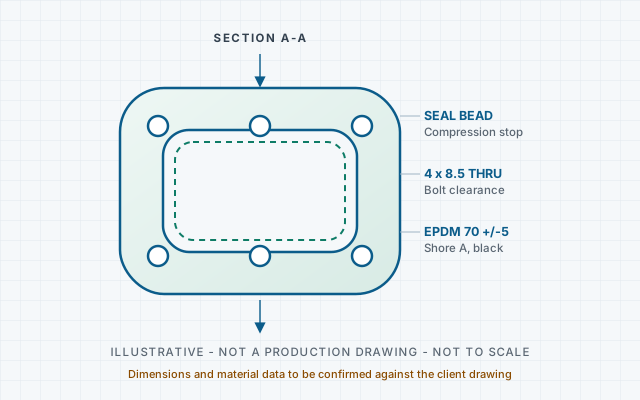
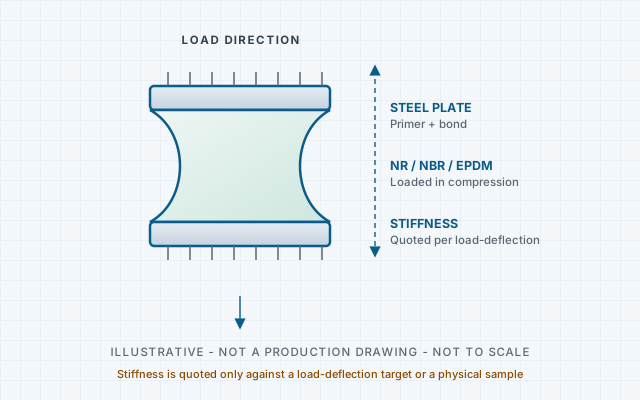
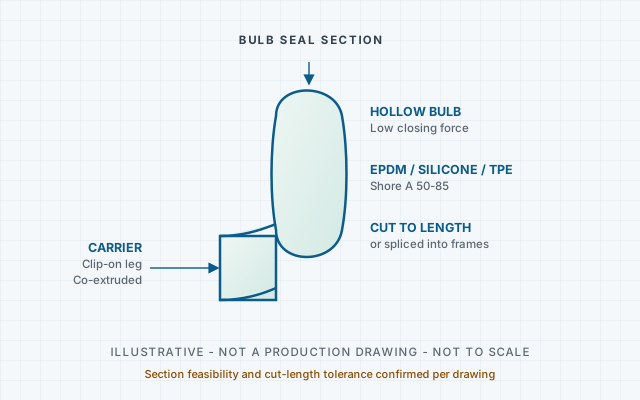
Three families we can quote from a drawing. Each product page documents material options, tolerance bands and the questions we ask before quoting.
How a drawing becomes a part
The sequence below is what we actually run. Each step produces a document the buyer can check.
Drawing review
We check geometry, tolerance stack-up and material callout, then flag anything we cannot hold.
Compound & tooling
Recommend a compound for the media and temperature, then propose tooling and cavity count.
Sample & report
First-article samples with dimensional report and material batch record.
Production
Batch traceability, in-process checks and pre-shipment inspection.
What we document
Buyers do not need marketing claims. They need to know which evidence exists and which does not. This table states both.
| Evidence | What it covers | Status |
|---|---|---|
| Dimensional inspection report | Critical dimensions vs drawing, per batch | Available |
| Material batch record | Compound lot, cure data, hardness check | Available |
| Hardness & tensile test | Shore A, tensile strength, elongation | confirm scope |
| RoHS / REACH declaration | Restricted substance compliance | confirm |
| ISO 9001 certificate | Quality management system | confirm |
| IATF 16949 | Automotive QMS | Not claimed |
| FDA food-contact | Material-specific, per compound | Not claimed |
Where these parts are used
Each application page states the media, temperature and standard that usually decide the compound — the questions a buyer should be able to answer before requesting a quote.
Weather and air sealing
Outdoor exposure, UV and ozone, −30 °C to 90 °C. EPDM is the usual starting point.
Fluid sealing
Media resistance decides the compound: NBR for oils, FKM for fuels and solvents, EPDM for water and steam.
Vibration isolation
Static load per mount, natural frequency and ambient temperature drive the design more than the rubber grade alone.
Buyer questions
Answered the way an engineer would ask them, not the way a brochure would.
What do you need from us to quote a custom rubber part?
A 2D drawing in PDF or DWG, or a 3D model in STEP or IGES; the media the part contacts; the operating temperature range; annual volume; and the destination market. If no drawing exists, a dimensioned sketch with the mating part is enough to begin.
Do you manufacture or trade?
Manufacturing happens in our own plant in Yixing, Jiangsu. Any separate export entity involved in the transaction is disclosed on the About page and in the quotation, so a buyer always knows which legal entity holds the certificate and which one invoices.
Which materials can you process?
EPDM, NBR, FKM, silicone, TPE/TPV and natural rubber for elastomer parts. Engineering-plastic components are available through a qualified partner where a rigid housing or insert is needed; the quotation states which parts are made in our plant and which are bought in. The specific grade is selected against the media, temperature and standard the part must meet, not by default.
How do you handle tooling ownership?
Tooling is quoted as a separate line item and its ownership is stated in the quotation. Where the buyer pays for tooling, the buyer owns it and the tool is retained in our plant for that buyer's production, with transfer terms agreed in writing.
What is your minimum order quantity?
MOQ depends on process and tooling: compression moulding and extrusion generally allow lower volumes than multi-cavity injection tooling. A stated MOQ is given with the quotation rather than as a blanket number.
Request a manufacturability review
Attach a drawing or describe the part. We reply with compound options, tolerance feasibility and lead time.
This is a concept site. In a production build the same form posts to the client's CRM or a form endpoint, notifies the export desk, and returns this receipt with a real reference number. The routing logic below is what a buyer would see.
-