Anti-vibration mounts
Bonded rubber-to-metal mounts for pumps, compressors, gensets and machinery. Load per mount, target frequency and environment decide the design — the drawing alone does not.
At a glance
- Process
- Bonded
- Material range
- Compound dependent; silicone for the upper range confirm
- Lead time
- Sample 10–15 days, production 3–5 weeks confirm
- MOQ
- Depends on tooling confirm
What decides the quote
Media, continuous and peak temperature, annual volume and the tolerance class all move the answer. A price quoted before those four are known is a placeholder, not an offer.
Send the drawing and the operating conditions together; that is what makes the first reply useful.
Technical specification
Figures below the tolerance line are process capabilities, not a promise for every geometry. A specific part is quoted against a stated class.
| Parameter | Value / basis |
|---|---|
| Process | Bonded moulding; over-moulding onto prepared metal or engineering-plastic inserts |
| Materials | NR for fatigue and low damping, NBR for oil contact, EPDM for outdoor and ozone, silicone for high temperature |
| Hardness | Shore A 40–70 typical for isolation mounts confirm |
| Substrate | Carbon steel, stainless, aluminium or engineering plastic; finish stated by buyer |
| Bond | Primer system matched to substrate; bond integrity checked at first article confirm |
| Load range | Set by geometry and hardness; stated per part after review confirm |
| Temperature | Compound dependent; silicone for the upper range confirm |
Customisation scope
What can change from part to part, and what has to be fixed before tooling.
| Item | What we can vary |
|---|---|
| Geometry | Cylindrical, rectangular, conical and custom profiles; compression or shear loaded |
| Stiffness | Tuned through hardness, geometry and bond area; verified against a load-deflection target where data is supplied |
| Substrate | Material, thickness, thread and finish to buyer drawing |
| Fail-safe feature | Interlocking or captive designs available where separation must be prevented |
| Testing | Static stiffness and bond check at first article; dynamic testing is external confirm |
Typical applications
| Application | What usually decides the specification |
|---|---|
| Pumps and compressors | Static load and running frequency; oil contact decides whether NBR is needed |
| Gensets and engines | Heat ageing and fuel/oil exposure; fatigue life matters more than peak load |
| HVAC fans and air handlers | Low-frequency isolation; deflection target usually drives the size |
| Transport and packaging | Shock rather than steady-state vibration; energy absorption decides the design |
Quality documentation
Which documents exist for this family, and which do not. The "not claimed" rows are deliberate.
| Document | Covers | Status |
|---|---|---|
| Dimensional inspection report | Metal and rubber dimensions against drawing | Available |
| Material batch record | Compound lot, cure data, hardness | Available |
| Bond inspection record | Visual and destructive sampling at first article | confirm |
| Static stiffness curve | Load-deflection to a stated target | confirm scope |
| Dynamic stiffness / transmissibility | Requires external laboratory | Not offered in-house |
| IATF 16949 | Automotive quality management system | Not claimed |
Buyer questions
How do I specify an anti-vibration mount?
Start with the static load per mount, the vibration frequency to isolate, the required deflection and the ambient conditions. The rubber grade is then chosen to survive the environment; the geometry is chosen to hit the stiffness target. A drawing alone, without load and frequency, cannot be quoted properly.
Do you supply the metal inserts too?
Yes. Substrate machining, surface preparation and the bonding process are part of the scope, and the bond is checked as part of first-article inspection. Substrate material and finish must be stated because they affect bond strength.
What is the difference between compression and shear mounts?
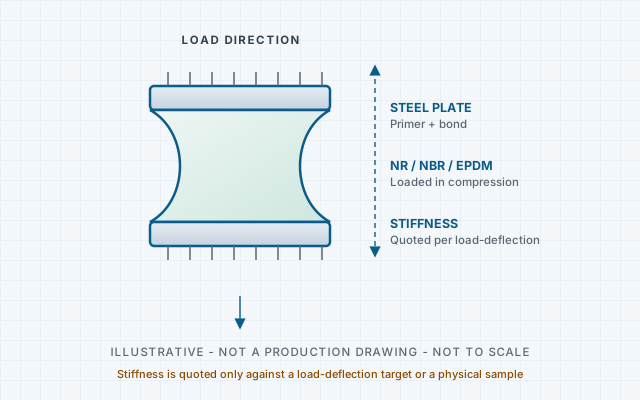
A compression mount carries load through the rubber in compression and is stiffer; a shear mount loads the rubber in shear and gives more deflection for the same size. The choice depends on the frequency you need to isolate and the space available.
Can you match the stiffness of an existing mount?
Only with a sample or a load-deflection curve. Stiffness is a measured property of a specific rubber compound, geometry and bond area; it is not a number that can be copied from a drawing. We ask for the current part or its test data.
Send a drawing, get a manufacturability review
Include the media, the temperature range and the standard the part must meet. That is what decides the compound.
Request a quote