Extruded profiles & seals
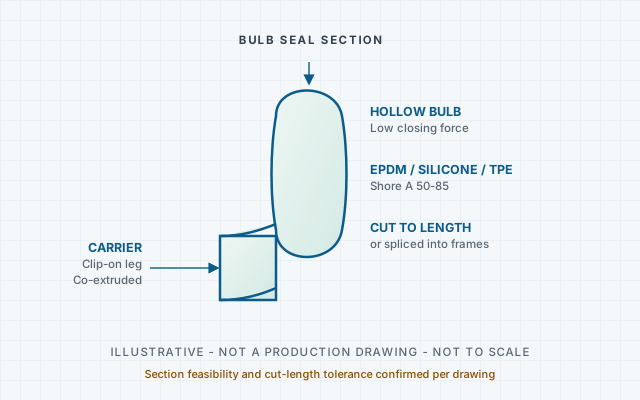
Continuous EPDM, silicone and TPE profiles — bulb, lip, D-section, hollow and cord — cut to length or spliced into frames. Die feasibility is checked before a die is cut.
At a glance
- Process
- Extruded
- Material range
- EPDM, silicone, TPE/TPV, NBR and NR
- Tolerance basis
- ISO 3302-2 for extruded sections confirm
- Lead time
- Sample 10–15 days, production 3–5 weeks confirm
- MOQ
- Depends on tooling confirm
What decides the quote
Media, continuous and peak temperature, annual volume and the tolerance class all move the answer. A price quoted before those four are known is a placeholder, not an offer.
Send the drawing and the operating conditions together; that is what makes the first reply useful.
Technical specification
Figures below the tolerance line are process capabilities, not a promise for every geometry. A specific part is quoted against a stated class.
| Parameter | Value / basis |
|---|---|
| Process | Continuous extrusion, hot or cold feed; cut to length, spliced or framed |
| Materials | EPDM, silicone, TPE/TPV, NBR, NR; co-extrusion with rigid carrier where needed |
| Hardness | Shore A 50–85 typical confirm |
| Section | Solid, hollow, bulb, lip, D-section, U-channel, cord and custom |
| Cut length | Tolerance stated per part and cut method confirm |
| Surface | Smooth, textured or flocked, depending on compound and die |
| Tolerance basis | ISO 3302-2 for extruded sections confirm |
Customisation scope
What can change from part to part, and what has to be fixed before tooling.
| Item | What we can vary |
|---|---|
| Section design | Reviewed for die feasibility: wall uniformity, undercuts, hollow support |
| Splicing | Vulcanised joint, corner moulding or mechanical clip |
| Lengths | Cut to length, coiled or in straight lengths to buyer packing preference |
| Carrier | Co-extruded rigid carrier for clip-on seals |
| Secondary | Punching, notching, adhesive tape, end caps |
Typical applications
| Application | What usually decides the specification |
|---|---|
| Doors and enclosures | Compression set and UV exposure; bulb or lip section chosen by closing force |
| Window and facade sealing | Weather and drainage; splice quality decides performance |
| Machine guarding | Edge protection and gap sealing; hardness and colour matter |
| Transport refrigeration and containers | Low temperature and ozone; EPDM usually preferred over NBR |
Quality documentation
Which documents exist for this family, and which do not. The "not claimed" rows are deliberate.
| Document | Covers | Status |
|---|---|---|
| Dimensional inspection report | Section dimensions against drawing, per batch | Available |
| Material batch record | Compound lot, cure data, hardness | Available |
| Cut length record | Measured lengths against stated tolerance | confirm scope |
| Splice strength test | Peel or tensile at the joint | confirm |
| RoHS / REACH declaration | Restricted substance compliance | confirm |
| ISO 9001 certificate | Quality management system | confirm |
| IATF 16949 | Automotive quality management system | Not claimed |
Buyer questions
What profile shapes can you extrude?
Solid, hollow, D-section, bulb, lip, U-channel, cord and custom sections. The limit is the die: a section needs uniform wall thickness where possible and no undercuts that cannot be drawn. Send the section drawing and we will say whether it is die-feasible.
Can extruded profiles be spliced into frames?
Yes. Corner splicing, vulcanised joints and moulded corners are available. The joint is usually the weak point in a frame seal, so the joint method is stated in the quotation rather than left to the buyer to discover.
What length tolerance applies to cut profiles?
Cut length tolerance depends on the cut method and the section stiffness. It is quoted per part; a blanket figure would be misleading on soft or hollow sections where the profile stretches during cutting.
Is extrusion cheaper than moulding for low volume?
Usually yes, because die cost is much lower than mould cost. That advantage disappears if the part needs tight dimensional control across the section, secondary operations or a spliced frame — those are priced separately.
Send a drawing, get a manufacturability review
Include the media, the temperature range and the standard the part must meet. That is what decides the compound.
Request a quote