Custom EPDM rubber gaskets
Moulded seals for enclosures, pumps, HVAC assemblies and outdoor equipment. Quoted against the media, the temperature range and the tolerance class the part actually needs — not against a catalogue size.
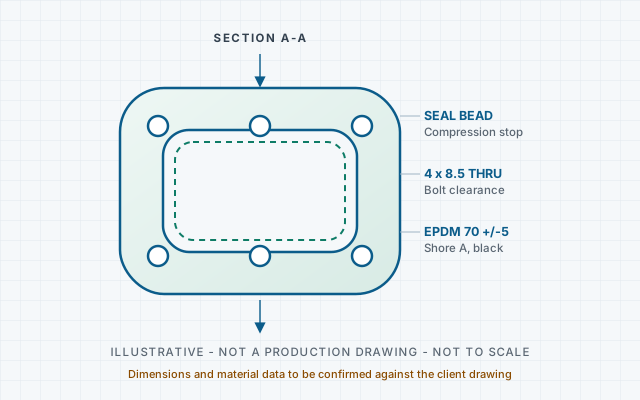
At a glance
- Process
- Moulded
- Material range
- EPDM standard; NBR, FKM, silicone and CR available
- Lead time
- Sample 10–15 days, production 3–5 weeks confirm
- MOQ
- Depends on tooling confirm
What decides the quote
Media, continuous and peak temperature, annual volume and the tolerance class all move the answer. A price quoted before those four are known is a placeholder, not an offer.
Send the drawing and the operating conditions together; that is what makes the first reply useful.
Technical specification
Figures below the tolerance line are process capabilities, not a promise for every geometry. A specific part is quoted against a stated class.
| Parameter | Value / basis |
|---|---|
| Process | Compression moulding; transfer moulding for intricate or thick sections |
| Materials | EPDM (peroxide and sulphur cured), NBR, FKM, silicone, CR, NR |
| Hardness | Shore A 40–90, depending on compound confirm |
| Tolerance basis | ISO 3302-1, class M2 / M3 depending on dimension confirm |
| Service temperature | EPDM typically −40 °C to +120 °C, compound dependent confirm |
| Colour | Black standard; other colours subject to compound and MOQ |
| Surface | Smooth, fabric finish or textured, mould dependent |
| Secondary operations | Deflashing, splicing, adhesive backing, film lamination |
Customisation scope
What can change from part to part, and what has to be fixed before tooling.
| Item | What we can vary |
|---|---|
| Geometry | Any 2D profile that can be cut into a mould; undercuts and deep draws reviewed case by case |
| Thickness | Set by compound and cure through section; thick sections reviewed for porosity risk |
| Cavity count | Chosen against annual volume and acceptable tool amortisation |
| Material | Selected against media, temperature, ozone/UV exposure and any standard named by the buyer |
| Packaging | Bulk, bagged, kitted or labelled to buyer instruction |
Typical applications
| Application | What usually decides the specification |
|---|---|
| Enclosures and cabinets | Outdoor UV and water exposure usually points to EPDM; IP rating target decides compression set allowance |
| Pumps and process equipment | Media resistance decides the compound; steam service excludes NBR |
| HVAC and air handling | Temperature band and ozone exposure; compression set over life matters more than tensile strength |
| Automotive-adjacent assemblies | Fluid contact and under-hood temperature; note that IATF 16949 is not claimed |
Quality documentation
Which documents exist for this family, and which do not. The "not claimed" rows are deliberate.
| Document | Covers | Status |
|---|---|---|
| Dimensional inspection report | Critical dimensions against drawing, per batch | Available |
| Material batch record | Compound lot, cure data, hardness check | Available |
| Hardness and tensile test | Shore A, tensile strength, elongation at break | confirm scope |
| Compression set data | Per ASTM D395 or ISO 815, method and duration stated | confirm |
| RoHS / REACH declaration | Restricted substance compliance for the compound | confirm |
| ISO 9001 certificate | Quality management system, certificate holder to be stated | confirm |
| IATF 16949 | Automotive quality management system | Not claimed |
| FDA food-contact | Material-specific, per compound and per test report | Not claimed |
Buyer questions
EPDM or NBR — which should I specify for my application?
EPDM resists weathering, ozone, water and steam and holds up outdoors, but swells in petroleum-based oils. NBR resists mineral oils, greases and fuels but degrades under ozone and sunlight. For combined outdoor and oil exposure neither alone is usually correct; the compound should be selected against the actual media and temperature range.
What tolerance can you hold on a moulded gasket?
Moulded rubber tolerances follow ISO 3302-1 and depend on dimension class, material hardness and geometry. Parts are quoted against a stated tolerance class rather than a single blanket figure, and dimensions that appear over-specified are flagged before tooling.
Can you make a gasket in a material that meets FDA or WRAS requirements?
Those are material-specific approvals attached to a particular compound and test report, not a property of the factory. If the application needs one, name the standard and the market; we will state whether a compliant compound is available and what evidence accompanies it.
How thick can a moulded gasket be?
Thickness is limited by cure through the section and by the tendency of thick sections to porosity or under-cure. The practical range depends on compound and geometry, which is why we ask for the drawing rather than quoting a universal maximum.
Who owns the tooling?
Tooling is quoted as a separate line item and ownership is stated in the quotation. Where the buyer pays for tooling, the buyer owns it and the tool is retained in our plant for that buyer's production, with transfer terms agreed in writing.
Send a drawing, get a manufacturability review
Include the media, the temperature range and the standard the part must meet. That is what decides the compound.
Request a quote